Everyone knows what a Brazilian fighter is. Jiu-jitsu, submissions, a back-take waiting behind every exchange. The stereotype is so settled it barely gets stated any more — it just sits underneath how fights get previewed.
The MMAHIT archive records a nationality for 307,578 fighters. Measuring how each country's fighters actually win breaks that stereotype in the first row, and then hands the title to somebody else.
The baseline
Across every decisive bout in the archive, wins arrive like this:
- KO/TKO — 36.4%
- Submission — 34.9%
- Decision — 26.5%
Every number below is a deviation from that.
Brazil is not the submission country
| Country | Wins | KO/TKO | Submission | Decision |
|---|---|---|---|---|
| Brazil | 61,174 | 40.0% | 35.1% | 23.2% |
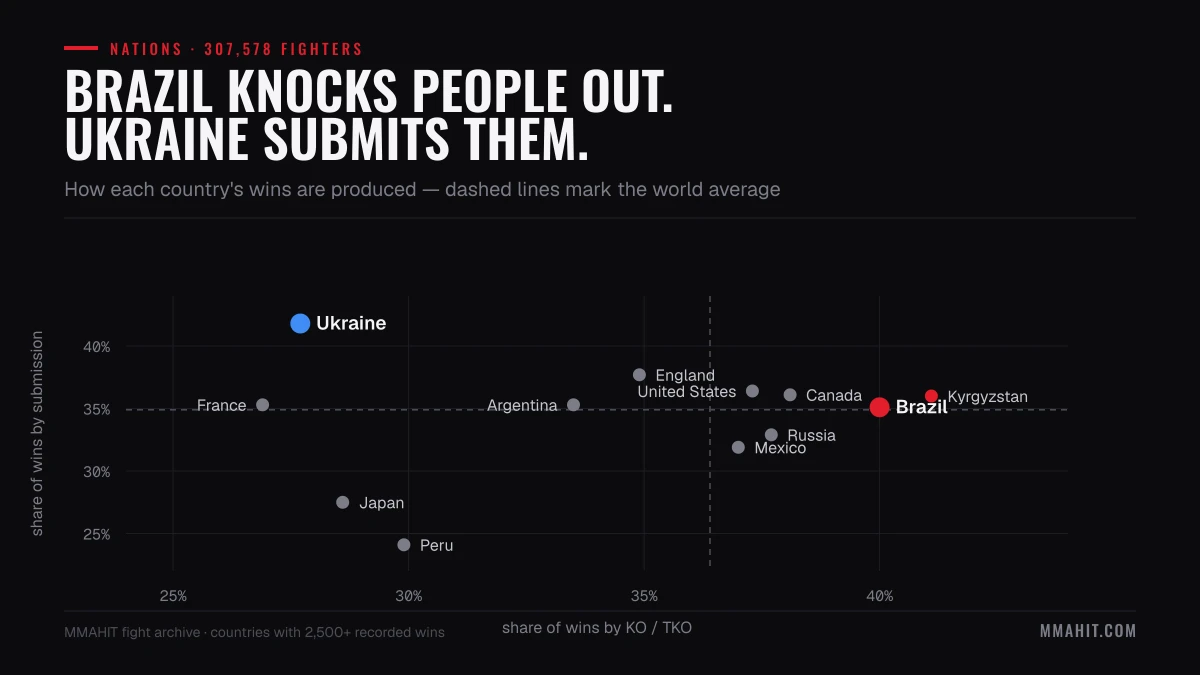
Brazilian submissions run at 35.1 percent — two-tenths of a point above the world average. For all the reputation, Brazilians finish fights on the ground at almost exactly the rate everybody else does.
Where Brazil is genuinely unusual is the other column. Forty percent of Brazilian wins are knockouts, nearly four points above baseline, and the decision rate is more than three points below it. The archive's Brazilian is not a grappler. He is a finisher, and more often than not he finishes with his hands.
The actual submission country is Ukraine
| Country | Wins | KO/TKO | Submission | Decision |
|---|---|---|---|---|
| Ukraine | 7,403 | 27.7% | 41.8% | 22.0% |
Nearly seven points above the world average on submissions, against Brazil's two-tenths. Ukrainian fighters submit opponents at a rate no other substantial nation approaches, while knocking people out nine points below average.
And this is not an artefact of some early era. Restricting to bouts from 2010 onward — where the baseline submission rate has drifted down to 33.2 percent — Ukraine sits at 41.8 percent, a gap of 8.6 points. The signature does not fade with the modern sport. It widens.
The explanation is not mysterious to anyone who follows the region: Ukraine's feeder system runs through combat sambo and wrestling, disciplines that put a premium on control and joint attacks rather than on exchanges at range.
The other ends of the scale
Kyrgyzstan — the most decisive nation in the sport. Only 18.5 percent of Kyrgyz wins go to the judges, against a world average of 26.5. Knockouts run at 41.1 percent. Whatever else happens in a Kyrgyz fighter's bout, it usually does not reach the scorecards.
Peru — the opposite. 44.5 percent of Peruvian wins are decisions, eighteen points above baseline, with the lowest submission rate of any major nation at 24.1 percent.
Japan — the country that goes the distance. 40.2 percent decisions and just 28.6 percent knockouts. It would be easy to write this off as an era effect, since so much of Japan's recorded volume comes from the Pancrase and PRIDE years. But restrict to 2010 onward and it holds almost exactly: 41.7 percent decisions, 29.9 percent knockouts. The domestic Japanese scene still produces fights that go to the cards.
France — the least knockout-prone. 26.9 percent of French wins are knockouts, nearly ten points below baseline and the lowest of any nation with more than 5,000 wins on record.
The full picture
| Country | Wins | KO/TKO | Submission | Decision |
|---|---|---|---|---|
| Kyrgyzstan | 5,447 | 41.1% | 36.0% | 18.5% |
| Brazil | 61,174 | 40.0% | 35.1% | 23.2% |
| Canada | 11,096 | 38.1% | 36.1% | 24.2% |
| Russia | 30,067 | 37.7% | 32.9% | 26.1% |
| United States | 145,200 | 37.3% | 36.4% | 25.0% |
| Mexico | 9,088 | 37.0% | 31.9% | 28.8% |
| England | 17,030 | 34.9% | 37.7% | 26.0% |
| Argentina | 6,518 | 33.5% | 35.3% | 29.2% |
| Peru | 5,391 | 29.9% | 24.1% | 44.5% |
| Japan | 22,879 | 28.6% | 27.5% | 40.2% |
| Ukraine | 7,403 | 27.7% | 41.8% | 22.0% |
| France | 9,540 | 26.9% | 35.3% | 36.5% |
The United States, with 145,200 recorded wins, sits within one and a half points of the world average on all three measures — which is what you would expect from the country that supplies the largest share of the sample. America is the baseline, more or less.
What to take from it
Check the reputation against the record. Brazil's grappling identity is real as a training culture and largely invisible in how Brazilians win. Reputation and result are different measurements and this sport routinely confuses them.
National style is a real thing and it survives the era test. Ukraine's submission edge, Kyrgyzstan's refusal to reach the judges and Japan's decision rate all hold when the analysis is restricted to the modern sport. These are not artefacts of when a country happened to be prominent.
And it is a feeder-system fingerprint, not a national temperament. Countries whose amateur pipeline runs through wrestling and sambo submit more. Countries whose pipeline runs through striking sports knock people out more. Where the fighters come from before MMA shows up in how they finish.
Method: figures drawn from the MMAHIT fight archive. Nationality is recorded for 307,578 of 347,296 fighters (88.6%) and refers to the fighter, not to where a given bout took place — the archive does not store event locations, so this measures national origin rather than home advantage. Draws and no contests are excluded. Countries are included at more than 2,500 recorded wins so a single prolific fighter cannot define one. Every claim was re-run restricted to bouts from 2010 onward, against a modern baseline of KO 36.5% / submission 33.2% / decision 28.4%; the national signatures named here all persist in that window, and Ukraine's submission edge grows from 6.9 to 8.6 points. One limitation stands: nationality is a coarse proxy for a training background, and fighters who train abroad are attributed to their passport rather than to the gym that shaped them.