"Undefeated" is the most loaded word in the sport. It sells fights, builds contenders and gets read out with a reverence no other statistic earns. It is also, in almost every case, temporary.
The MMAHIT archive holds a dated, decisive record for 333,954 fighters. Sorting each career by date and finding where the first loss lands turns the word into a number.
A perfect record is rarer than almost anyone assumes
| Reached | Fighters | Share of everyone |
|---|---|---|
| 1-0 | 137,117 | 41.1% |
| 2-0 | 47,372 | 14.2% |
| 3-0 | 22,604 | 6.8% |
| 5-0 | 7,023 | 2.1% |
| 10-0 | 748 | 0.2% |
| 15-0 | 119 | 0.04% |
| 20-0 | 22 | — |
| 30-0 | 2 | — |
Two fighters in the entire recorded history of the sport have opened a career with thirty consecutive wins. Twenty-two have managed twenty.
Put the other way: for every fighter who reaches 10-0, roughly 446 never get past their first win.
The part that runs backwards
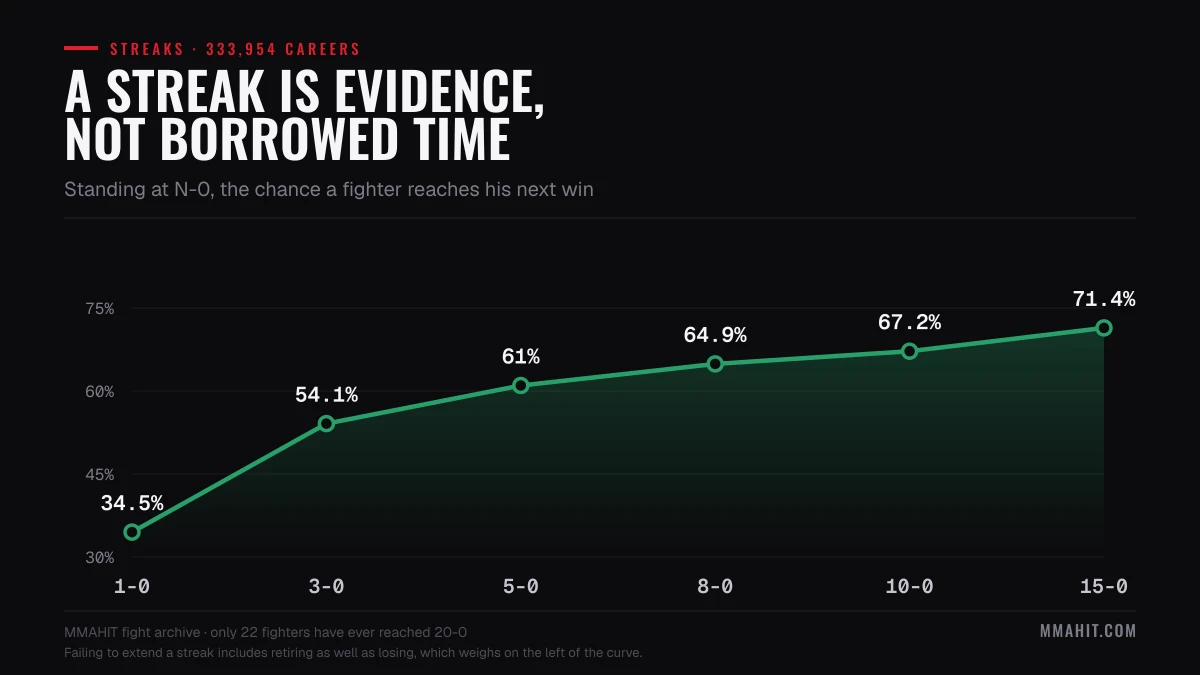
Now ask a conditional question. Given that a fighter is already N-0, what are the odds he makes it to (N+1)-0?
| Standing at | Goes on to the next win |
|---|---|
| 1-0 | 34.5% |
| 3-0 | 54.1% |
| 5-0 | 61.0% |
| 8-0 | 64.9% |
| 10-0 | 67.2% |
| 15-0 | 71.4% |
The line goes up. A man at 15-0 is more than twice as likely to extend his streak as a man at 1-0.
That is the opposite of how streaks are usually discussed. The language around an unbeaten run — "due", "regression", "living on borrowed time" — assumes a rising risk, as though the streak were spending down some finite credit. The archive says the reverse: every additional win is evidence, and the evidence keeps getting stronger.
There is an honest qualifier here and it matters. Failing to reach the next win includes two different endings: losing, and simply never fighting again. At 1-0 the second is enormous — this archive is more than half one-fight careers — so a good part of that 34.5 percent is men who walked away rather than men who were beaten. By 8-0 or 10-0 that contamination is small, and the curve is still climbing. The effect survives the caveat; it just does not own all of the bottom row.
The longest opening runs on record
| Run | Fighter | Career | |
|---|---|---|---|
| 31-0 | Luis Rafael Laurentino | 47 bouts | Brazil |
| 30-0 | Julio Cesar Neves Jr. | 39 bouts | Brazil |
| 29-0 | Khabib Nurmagomedov | 29 bouts | never lost |
| 28-0 | John Strawn | 49 bouts | United States |
| 27-0 | Yaroslav Amosov | 31 bouts | Ukraine |
| 24-0 | Movlid Khaybulaev | 24 bouts | never lost |
| 23-0 | Khusein Askhabov | 25 bouts | UAE |
| 22-0 | Megumi Fujii | 29 bouts | Japan |
Two names on that list have no fight after the streak because the streak never ended. Khabib Nurmagomedov retired at 29-0 — a figure the archive reproduces exactly, and one of only four fighters in the whole database to reach twenty consecutive wins and never lose at all.
The two men above him did eventually lose. Luis Rafael Laurentino opened 31-0 and fought on to 47 bouts; John Strawn went 28-0 and finished with 49. A longer perfect run than Khabib's exists in the record — it just did not stay perfect, which is the entire reason nobody talks about it.
And then it ends
Take every fighter who lost for the first time and then had at least three more bouts — 54,512 of them — and measure what came next.
Before the first loss they are, by definition, unbeaten. Afterwards, across 444,963 bouts, they win 51.6 percent.
A perfect fighter becomes a coin flip. Not a collapse — half of professional bouts are won by definition, so 51.6 is fractionally above the water line — but the aura is gone in a single night and it does not come back as an average.
Unless the streak was long
That average hides something. Split the same fighters by how long their unbeaten run had been:
| Unbeaten run | Fighters | Win rate afterwards |
|---|---|---|
| 1-0 or 2-0 | 16,773 | 53.3% |
| 3-0 / 4-0 | 5,095 | 57.2% |
| 5-0 to 7-0 | 2,516 | 58.9% |
| 8-0 to 11-0 | 860 | 59.3% |
| 12-0 or better | 214 | 63.1% |
Ten points separate the men who lost early from the men who lost late. A fighter who was 12-0 before his first defeat still wins nearly two in three afterwards.
So the streak was never the illusion. It was measuring something real about the fighter, and that something does not evaporate when the record does — the first loss removes the zero, not the ability. What ends is the marketing, not the fighter.
What to do with it
Treat a long unbeaten record as evidence, not as a bubble. The conditional odds improve with every win in this archive, from 34.5 percent at 1-0 to 71.4 percent at 15-0. Nothing here supports the idea that a streak is "due" to end.
But read the number, not the word. 2-0 and 20-0 are both "undefeated" and they are separated by roughly six thousand fighters. Almost every unbeaten record being sold to you is at the shallow end.
A first loss is not the end of anything. Fighters who were 12-0 going in win 63.1 percent of what follows. The ones who never recover are overwhelmingly the ones who were 1-0 or 2-0 — where the streak was never evidence of much in the first place.
Method: figures drawn from the MMAHIT fight archive. Careers are ordered by event date across 333,954 fighters holding at least one dated decisive bout; draws and no contests are excluded, so an "unbeaten run" here counts consecutive wins from the professional debut to the first recorded loss. Three limitations. First, failure to extend a streak includes retiring as well as losing, which inflates the attrition at the shallow end — this archive is more than half one-fight careers, and that is disclosed rather than corrected for. Second, the deepest rows rest on tiny samples: 22 fighters reached 20-0 and 2 reached 30-0, so the survival figures above 15-0 are reported for completeness and should not be read as stable. Third, the archive under-records the smallest regional shows, which can make an early loss invisible and a streak look longer than it was; the leading names were checked against public records, and Khabib Nurmagomedov's 29-0 matches exactly.