The rematch is the story MMA tells better than any other sport. A man loses, disappears into a gym for a year, and comes back to settle it. Every promotion builds cards around that arc because every fan wants to believe the second fight is a blank page.
The archive says it usually isn't.
We collapsed every bout in the MMAHIT archive down to one row per meeting — 562,186 meetings between 549,270 distinct pairs of fighters — and looked for the pairs who met more than once.
First, the thing nobody mentions: it almost never happens
12,127 pairs have fought each other twice or more. That is 2.2 percent of all the pairings in the sport's recorded history.
Trilogies are rarer still: 698 pairs have met three times. Seventy-four pairs have met four times or more.
So before anything else, understand that the rematch is not a normal event. Roughly forty-nine out of every fifty fights that have ever happened were the only time those two men shared a cage.
And when it does happen, the answer usually stays the same
Taking the 11,035 pairs whose first two meetings both produced a winner:
| Second meeting | Rematches | Share |
|---|---|---|
| The first winner won again | 7,486 | 67.8% |
| The first loser avenged it | 3,549 | 32.2% |
Slightly better than two to one. The average gap between the two fights is 558 days — a year and a half of training, corrections and preparation — and at the end of it the same man wins roughly seven times in ten.
That figure is not ours alone. Independent analyses built on UFC and major-promotion data put the same number at 64.5 percent, close enough across two completely different samples to treat the effect as real rather than as an artefact of one database.
How the first fight ended changes the odds
Not every loss is equally reversible.
| How fight 1 was won | Rematches | Winner repeated |
|---|---|---|
| By submission | 3,823 | 71.4% |
| By KO/TKO | 3,322 | 70.8% |
| On points | 3,535 | 62.0% |
If the first fight was finished, the man who finished it wins the rematch about 71 percent of the time. If it went to the judges, that drops to 62.
A nine-point gap. And again the outside work agrees on the direction: published rematch analyses report the first winner's repeat rate rising from 64.5 percent overall to 67.7 percent when the first fight ended in a knockout or submission. Different sample, same mechanism.
A decision loss is a genuinely different thing from a stoppage loss. It says the two men were close enough that a panel had to choose, and closeness is the one condition under which a rematch is worth booking on merit rather than on narrative.
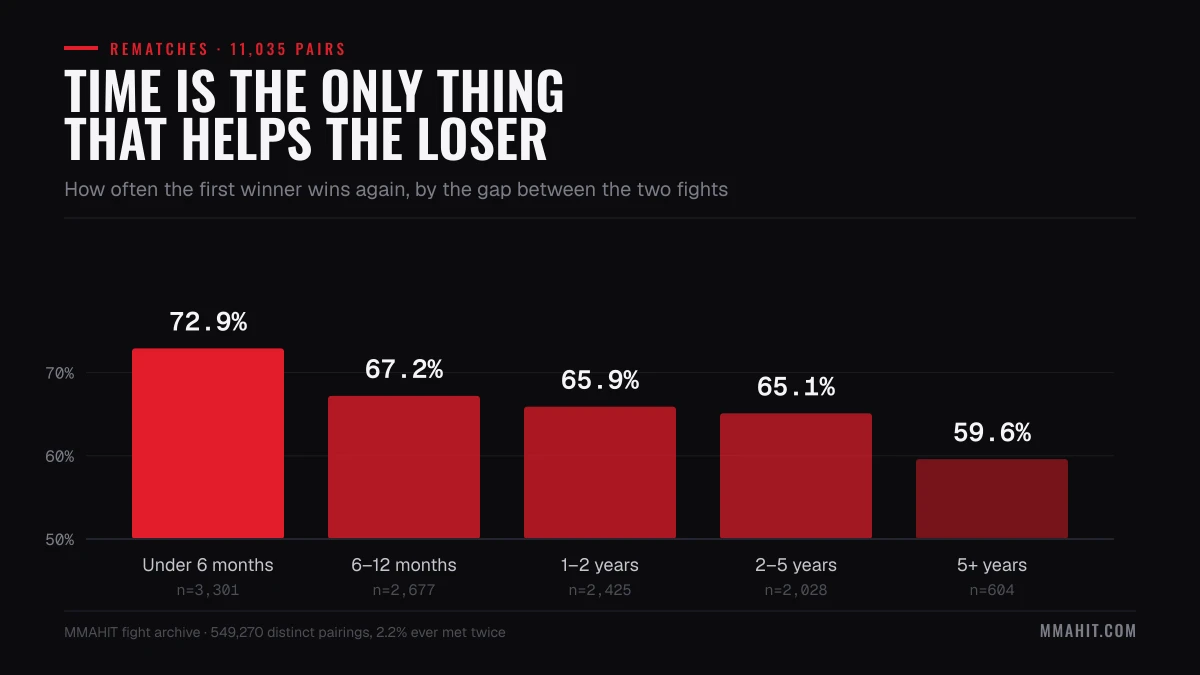
Time is the only thing that reliably helps the loser
This is the finding worth keeping.
| Gap between the fights | Rematches | Winner repeated |
|---|---|---|
| Under 6 months | 3,301 | 72.9% |
| 6–12 months | 2,677 | 67.2% |
| 1–2 years | 2,425 | 65.9% |
| 2–5 years | 2,028 | 65.1% |
| 5+ years | 604 | 59.6% |
Straight line, every step. A fighter who gets his rematch inside six months loses it 72.9 percent of the time. A fighter who waits five years loses it 59.6 percent of the time.
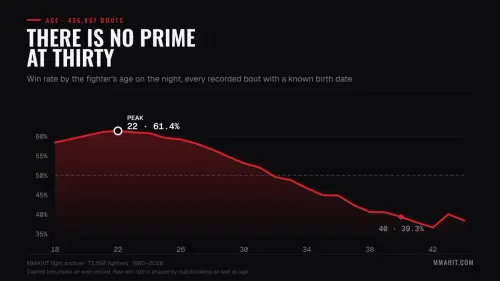
Thirteen points is not a small edge in a sport where most things move outcomes by two or three. And the mechanism is not mysterious: an immediate rematch is the same two fighters with the same tools and the same problem. Five years is enough time for one man to have added something, or for the other to have aged out of what made him better — and, as the archive shows elsewhere, being the older fighter is worth about seven points on its own.
The quick rematch is the one that feels most dramatic and the one least likely to change anything. The forgotten grudge, dragged out half a decade later, is where upsets actually live.
The trilogy turns the logic upside down
Now take the 312 pairs who went 1–1 and fought a third time, and ask who took the decider.
Not the man who won first. The fight-1 winner took the trilogy only 44.9 percent of the time — meaning the man who won most recently wins the third fight about 55 percent of the time.
That is a small sample and deserves to be read carefully. But it points at something intuitive: once a rivalry is level, the archive stops caring who won at the beginning and starts favouring whoever won last. History gets overwritten by recency. In a trilogy, the man walking in off a win over this specific opponent is the one holding the useful information.
The pairs who could not leave it alone
| Meetings | Fighters | Span |
|---|---|---|
| 6 | Bryan Robinson vs Nate Kopel | 2002–2008 |
| 5 | Guy Mezger vs Ryushi Yanagisawa | 1995–1998 |
| 5 | Yuki Kondo vs Kiuma Kunioku | 1996–1999 |
| 5 | Rafael Addario Bastos vs Adson Lira Nascimento | 2005–2011 |
| 5 | Elias Monteiro vs Silmar Nunes | 2010–2019 |
| 5 | Bibiano Fernandes vs Kevin Belingon | 2016–2025 |
| 5 | Jakub Wiklacz vs Sebastian Przybysz | 2017–2024 |
| 5 | Antonio Gordillo vs Ricardo Chavez | 2022–2025 |
Two of these are worth pausing on.
Mezger and Yanagisawa met five times in Pancrase between 1995 and 1998, and the first of those meetings was a draw — exactly the kind of fight that a decisive-results-only query quietly deletes. Kondo and Kunioku are the same story twice over: two of their five meetings ended without a winner at all under the Pancrase rules of the era. Any rivalry table that counts only fights with a winner will report both of these pairs wrongly, and will start their rivalries a year or more late.
Wiklacz and Przybysz arrive with their own proof of the count. KSW named the events after the rivalry itself — the fourth meeting was billed as KSW 86: Wiklacz vs. Przybysz 4 and the fifth as KSW 95: Wiklacz vs. Przybysz 5. When a promotion numbers a series in its own event titles, the archive and the sport are counting the same way.
Seventy-four pairs in the entire recorded history of the sport have met four times. That is how rare a genuine rivalry is.
What to do with this
Treat "he'll fix it in the rematch" as a claim, not a default. It happens about a third of the time. The base rate is the first thing to know and the last thing anybody says out loud.
Ask how the first fight ended before you ask anything else. A decision loss is roughly 62–38. A knockout loss is closer to 71–29.
Ask how long it has been. The gap between the two fights moves the number more than almost any other single fact available before the bell.
And in a trilogy, throw out fight one. After a 1–1 split, the archive says the recent result is the more reliable guide — the opposite of how these fights are usually sold.
Method: figures drawn from the MMAHIT fight archive. The archive stores one row per fighter per bout, so each meeting appears twice, once from each corner; every meeting here is collapsed to a single canonical row keyed on the ordered pair of fighter ids and the event date, which is why the repeat-pairing count is 12,127 rather than the doubled figure a naive query returns. Draws and no contests are counted as meetings — an earlier version of this analysis excluded them and consequently reported the Mezger–Yanagisawa rivalry as four fights beginning in 1996 rather than five beginning in 1995. The outcome questions still require both compared fights to have produced a winner, which is why those tables rest on 11,035 pairs rather than 12,127. Named records were checked against public sources before publication: Dan Severn's 127 bouts, Shannon Ritch's 150, Jeremy Horn's 120 and the five-fight Fernandes–Belingon series all match the standard record. Two limitations: only bouts where both fighters resolve to archive ids can be paired, so meetings involving an unidentified opponent are not counted; and the trilogy analysis rests on 312 cases, which is enough to be suggestive and not enough to be settled.