Nobody in this sport is argued about more cheaply than the third man in the cage. Every stoppage is early to somebody and late to somebody else, and the argument never advances because it is always about one fight.
The MMAHIT archive records the referee for 307,077 bouts across 2,325 officials. That is enough to stop arguing about one fight.
It is also enough to get the answer badly wrong, which is where this has to start.
The table that looks convincing and isn't
Take every UFC bout in the archive with a referee attached, group by official, and measure how often the fight ended in a stoppage. You get a spread that looks decisive — John McCarthy at 41.0 percent, Chris Tognoni at 29.3, a gulf of nearly twelve points between them.
Now look at when those two men worked.
John McCarthy officiated from 1994 to 2017; only a quarter of his bouts came after 2015. Chris Tognoni started in 2010 and 93 percent of his work is post-2015. They are barely officiating the same sport.
Because the sport moved underneath them:
| UFC era | Bouts | Stoppage rate |
|---|---|---|
| 1990s | 450 | 48.9% |
| 2000s | 2,060 | 40.0% |
| 2010s | 8,232 | 31.8% |
| 2020s | 6,608 | 32.2% |
The stoppage rate has fallen by seventeen points since the nineties — the same defensive-competence story the archive tells everywhere else. Which means any referee who worked the early era looks quick to stop a fight, and any referee who came up recently looks patient, whatever either of them actually does.
That table measures the calendar, not the official.
Fixing it
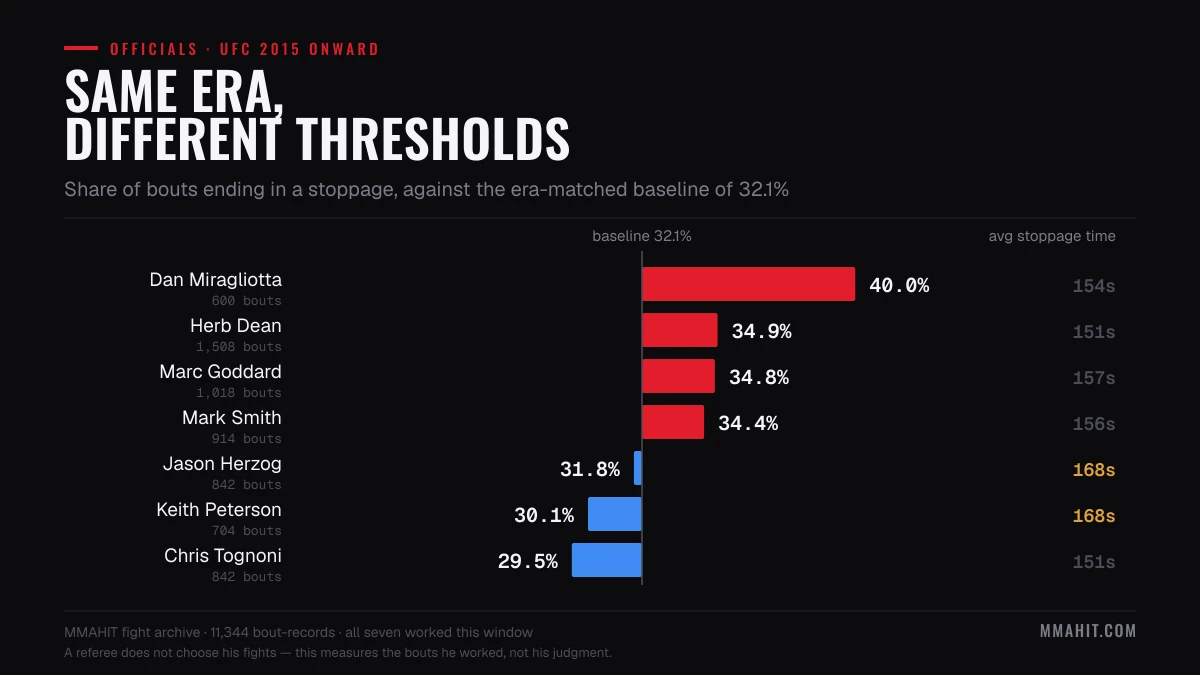
So restrict the comparison to a window where all of these men worked simultaneously: UFC bouts from 2015 onward, 11,344 records. In that window the baseline is 32.1 percent stoppages, and the average stoppage arrives 158 seconds into whichever round it happens in.
Measured against that shared baseline:
| Referee | Bouts | Stoppage rate | vs baseline | Avg stoppage time |
|---|---|---|---|---|
| Dan Miragliotta | 600 | 40.0% | +7.9 | 154s |
| Herb Dean | 1,508 | 34.9% | +2.8 | 151s |
| Marc Goddard | 1,018 | 34.8% | +2.7 | 157s |
| Mark Smith | 914 | 34.4% | +2.3 | 156s |
| Jason Herzog | 842 | 31.8% | −0.2 | 168s |
| Keith Peterson | 704 | 30.1% | −2.0 | 168s |
| Chris Tognoni | 842 | 29.5% | −2.6 | 151s |
The gap survives the control. It is smaller than the naive version — ten and a half points rather than twelve — but it does not go away.
Is ten points more than luck?
Worth checking rather than assuming. At the smallest sample here, 600 bouts, one standard deviation of pure chance around a 32 percent rate is about ±1.9 points. A spread of 10.5 points is more than five times that.
This is not sampling noise. Something real separates the top of that table from the bottom.
The consistency check
If a referee has a genuine threshold, his own number should travel with him. Three of these officials have enough pre-2015 work to test:
- Dan Miragliotta — 37.0% before 2015, 40.0% after. The quickest stopper in both windows.
- Herb Dean — 37.5% before, 34.9% after. Drifted down with the sport, stayed above baseline.
- Marc Goddard — 27.4% before, 34.8% after. Moved the other way.
Miragliotta is the cleanest case in the archive: high in the old era, higher still in the new one, while the sport around him was moving in the opposite direction.
Two different jobs, apparently
Read the last column and a second pattern appears that has nothing to do with the first.
Jason Herzog and Keith Peterson both stop fights at 168 seconds — a full ten seconds later than the baseline, and seventeen seconds later than Herb Dean or Chris Tognoni. In a sport where a fight can turn in two seconds, ten is not decorative.
But Herzog sits at the baseline for stoppage rate while Peterson is below it, and Tognoni has the lowest rate in the table while stopping fights among the earliest. Rate and timing are measuring different things: how readily a referee reaches for a fight, and how long he lets the ending run once he has decided it is coming.
The limit of all this, stated plainly
A referee does not cause a stoppage. He is handed a fight card he did not choose.
If one official works more main events, or more heavyweight bouts, or more of a promotion's violent divisions, his stoppage rate rises without his judgment changing at all. This archive records who was in the cage, not why he was assigned there, and no amount of era-matching fixes that.
So the honest reading of the table is: fights officiated by Dan Miragliotta end in a stoppage far more often than fights officiated by Chris Tognoni. Whether that is threshold or assignment, the data cannot say — though the fact that Miragliotta's number holds across two eras and a changing sport points more toward the man than the draw.
None of this is a scorecard on competence. Stopping a fight is a decision made in a second with a person's health on the far side of it, and there is no number in this archive that knows whether any individual call was right.
What is actually usable
Never compare referees across eras. The single most cited referee statistic in this sport is contaminated by a seventeen-point drift in how the sport itself ends. Any table that does not name its window is telling you about the calendar.
Rate and timing are separate questions. Herzog and Peterson are the patient ones by the clock. Miragliotta is the decisive one by frequency. Those are different traits and they do not travel together.
And ten points is a real number. Across 11,344 modern UFC bouts, which official is assigned genuinely tracks how the night is likely to end — by a margin five times larger than chance would produce.
Method: figures drawn from the MMAHIT fight archive, which records a referee for 307,077 of 1,049,038 bouts (29.3%) across 2,325 officials. The controlled comparison is restricted to UFC bouts from 2015 onward — 11,344 bout-records — because the promotion is identifiable from the event name, referee coverage there is 96.3%, and all seven officials in the table worked that window simultaneously. Draws and no contests are excluded. "Stoppage" means a recorded KO or TKO; submissions and decisions are counted separately. Stoppage time is the recorded clock time within the finishing round, averaged over stoppages only, and is available for bouts whose time is stored in m:ss form. The chance calculation uses the standard error of a proportion at the smallest sample in the table (n=600). The limitation that cannot be engineered away is assignment: referees do not choose their fights, and this archive has no record of why a given official was given a given bout.