Every broadcast reads them out before the walkouts. Height, reach, sometimes leg length, delivered in the tone of a man explaining who is about to win. The tale of the tape is the oldest piece of furniture in combat sports.
The MMAHIT archive has a recorded height for 105,372 fighters, which gives 414,240 bout-sides where we know how tall both men were. That is enough to stop describing the tale of the tape and start scoring it.
Height does matter. It matters much less than the way it gets talked about.
The test
Comparing tall fighters to short fighters across different bouts would tell us nothing — eras, promotions and matchmaking would all be baked in. So compare the two men inside a single fight, where everything except the difference between them is held constant by definition.
| Height advantage | Bouts | Taller man won |
|---|---|---|
| Any margin | 174,491 | 52.3% |
| 5cm or more | 116,799 | 53.1% |
| 10cm or more | 39,512 | 54.3% |
| 15cm or more | 9,696 | 55.5% |
| 20cm or more | 1,935 | 56.2% |
A clean dose-response: the bigger the gap, the better the taller man does, at every step. The effect is real and it is not noise.
Now read the last row again. Twenty centimetres is nearly eight inches — the difference between a 175cm fighter and a 195cm one, a gap so visible the fight looks like a mismatch in the promotional photo. It buys a 56.2 percent win rate. Six points over a coin flip.
The comparison that puts it in place
We measured age in this archive using exactly the same method: put both men in the same bout and vary one thing.
A fighter who is three or more years younger than his opponent wins 59.6 percent of the time.
So being three years younger is worth more than being eight inches taller. The advantage every broadcast announces is smaller than the one almost nobody mentions.
It does get more important as the men get bigger
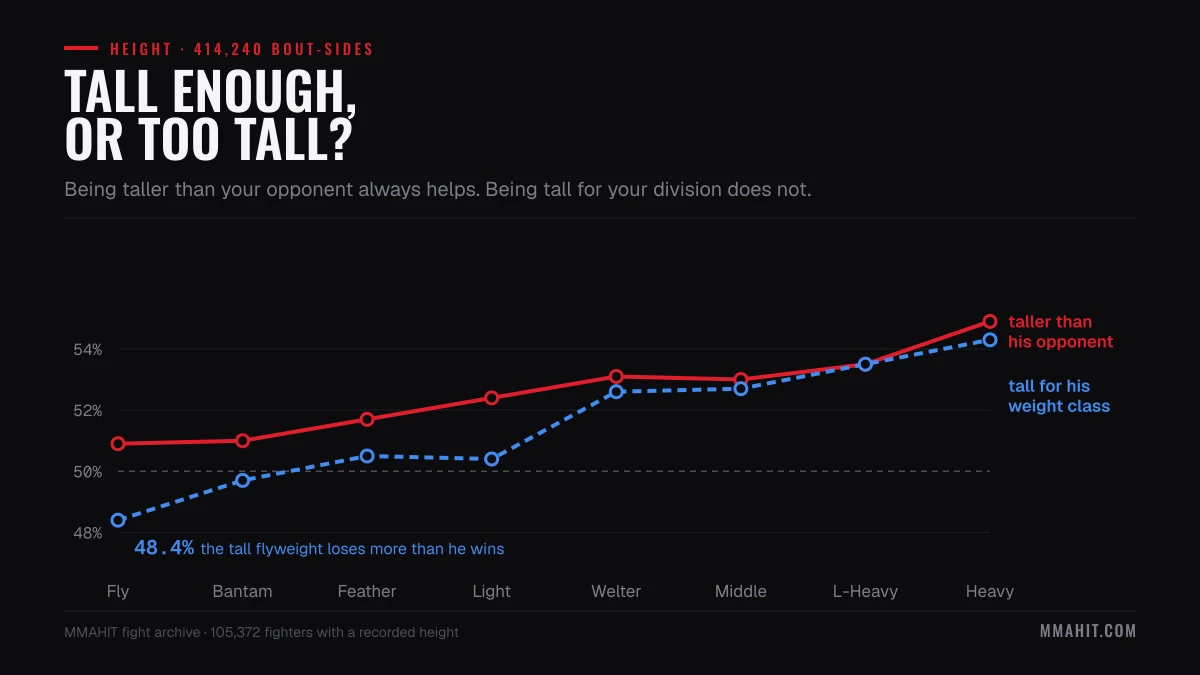
Split the same test by division and a clean line appears:
| Division | Bouts | Taller man won |
|---|---|---|
| Flyweight | 13,522 | 50.9% |
| Bantamweight | 23,156 | 51.0% |
| Featherweight | 27,983 | 51.7% |
| Lightweight | 30,010 | 52.4% |
| Welterweight | 29,166 | 53.1% |
| Middleweight | 19,735 | 53.0% |
| Light Heavyweight | 12,123 | 53.5% |
| Heavyweight | 12,832 | 54.9% |
At flyweight, being the taller man is worth nine-tenths of a percentage point — statistically indistinguishable from nothing. At heavyweight it is worth almost five. The heavier the division, the more the reach is attached to something that can hurt you.
And here is the part that reverses
The table above measures being taller than your opponent. Ask a different question — is it good to be tall for your weight class? — and the answer flips at the bottom of the scale.
Taking fighters at least 5cm above their division's average height:
| Division | Division average | Win rate of the tall-for-class |
|---|---|---|
| Flyweight | 166.6cm | 48.4% |
| Bantamweight | 170.0cm | 49.7% |
| Featherweight | 173.0cm | 50.5% |
| Lightweight | 175.7cm | 50.4% |
| Welterweight | 178.7cm | 52.6% |
| Middleweight | 181.1cm | 52.7% |
| Light Heavyweight | 183.2cm | 53.5% |
| Heavyweight | 185.4cm | 54.3% |
An unusually tall flyweight wins 48.4 percent of his fights. He is below even.
There is no contradiction here, only a trade. Being taller than the man in front of you is an advantage. Being tall for a weight limit means carrying that frame at a weight built for a smaller frame — the same 57kg spread over more skeleton, which is less muscle per centimetre. In the light divisions that cost outweighs the reach. Somewhere around welterweight the two cross over, and above it the height stops costing anything.
The lanky flyweight is fighting his own body. The lanky heavyweight is not.
The taller man knocks you out; the shorter man out-points you
Sort the wins by who was taller and the routes diverge:
| KO/TKO | Submission | Decision | |
|---|---|---|---|
| Taller man's wins | 38.7% | 32.5% | 27.2% |
| Shorter man's wins | 34.1% | 31.8% | 32.3% |
When the shorter fighter wins, he is meaningfully more likely to have done it on the scorecards — 32.3 percent against 27.2. He gets inside, he accumulates, he survives to the horn and takes the round.
The height advantage is mostly a striking advantage, and striking advantages produce knockouts. Take that away and what is left is a decision.
Which brings us to Minowaman
The archive holds 1,935 bouts with a gap of 20cm or more. The most extreme of them belong to one man, and he was the short one.
Ikuhisa Minowa stands 175cm. In 2006 he fought Paulo Cesar Silva — "Giant Silva", 218cm — and won by TKO from knees. In October 2009 he fought Hong Man Choi, also 218cm, and submitted him with a heel hook. Both gaps are 43 centimetres: seventeen inches.
He is nicknamed The Giant Killer, and the archive backs the nickname without knowing it exists.
It also refuses to romanticise him. Against opponents of 200cm or more, Minowa's record in this archive is two wins and two losses — he lost to Semmy Schilt at 211cm and to Wagner da Conceição Martins at 201cm. The giant killer beat the giants half the time, which is roughly what a 56.2 percent baseline predicts for the men on the other side.
What to take from the tape
The tale of the tape is real but oversold. Eight inches of height moves the needle six points. It is a factor, not a verdict, and it is routinely presented as a verdict.
Ask which division before you ask how tall. The same centimetre is worth roughly five times more at heavyweight than at flyweight.
Be suspicious of the tall small man. At flyweight and bantamweight, being well above the division's average height is associated with a below-even record. The reach reads well on the graphic and costs him elsewhere.
And if the short man is going to win, expect it to take three rounds. He gets there on points far more often than the tall man does.
Method: figures drawn from the MMAHIT fight archive. Height is recorded for 105,372 of 347,296 fighters (30.3%), giving 414,240 bout-sides where both men's heights are known; draws and no contests are excluded. All head-to-head figures compare the two fighters within a single bout, which controls for era, promotion and matchmaking by construction. A plausibility gate of 140–220cm is applied throughout: 32 fighters carry an obviously mis-transcribed height — one welterweight is recorded at 76cm — which manufactured an impossible 89cm "mismatch" in an earlier pass. Removing those rows changed none of the headline figures to one decimal place. Two limitations: the archive stores height but not reach, so the reach half of the tale of the tape cannot be tested here; and the tall-for-class table is a group win rate rather than a head-to-head comparison, so it carries the confounds the rest of the piece avoids — it is reported because the direction is consistent across all eight divisions, not because any single row is decisive.