Every ranking you have ever read is the tip of something enormous and almost entirely undocumented.
The MMAHIT archive holds records for 336,562 fighters who have at least one dated professional bout. The famous ones — the champions, the contenders, the men whose names get read out on pay-per-view — number in the low hundreds. Below them sit tens of thousands of working professionals who fought for years in regional promotions nobody outside their own city has heard of.
And below them sits the largest group in the sport by a wide margin: 177,840 people who fought professionally exactly once, and never came back.
That is 52.8 percent of everyone in the archive. More than half of all professional mixed martial artists in recorded history have a career that consists of a single night.
What that one night looked like
For most of them it did not go well.
| The one and only fight | Fighters | Share |
|---|---|---|
| They lost | 122,060 | 68.6% |
| They won | 53,221 | 29.9% |
| Draw or no contest | 2,559 | 1.4% |
And when they lost, they mostly did not lose narrowly. Of those 122,060 defeats, 41.2 percent came by knockout or TKO and 36.3 percent by submission. Only 19.9 percent went to the judges.
It was also usually fast. Among the debut losses that ended in a finish, 66,484 came in the first round — roughly seven in ten. For a very large number of people, the entire professional career lasted less than five minutes and ended with somebody standing over them.
The finding: it is not whether you lost. It is how.
Here is the part that surprised me.
You would expect losing your debut to predict quitting, and it does — 62.4 percent of fighters who lost their first bout never had a second, against 39.2 percent of those who won.
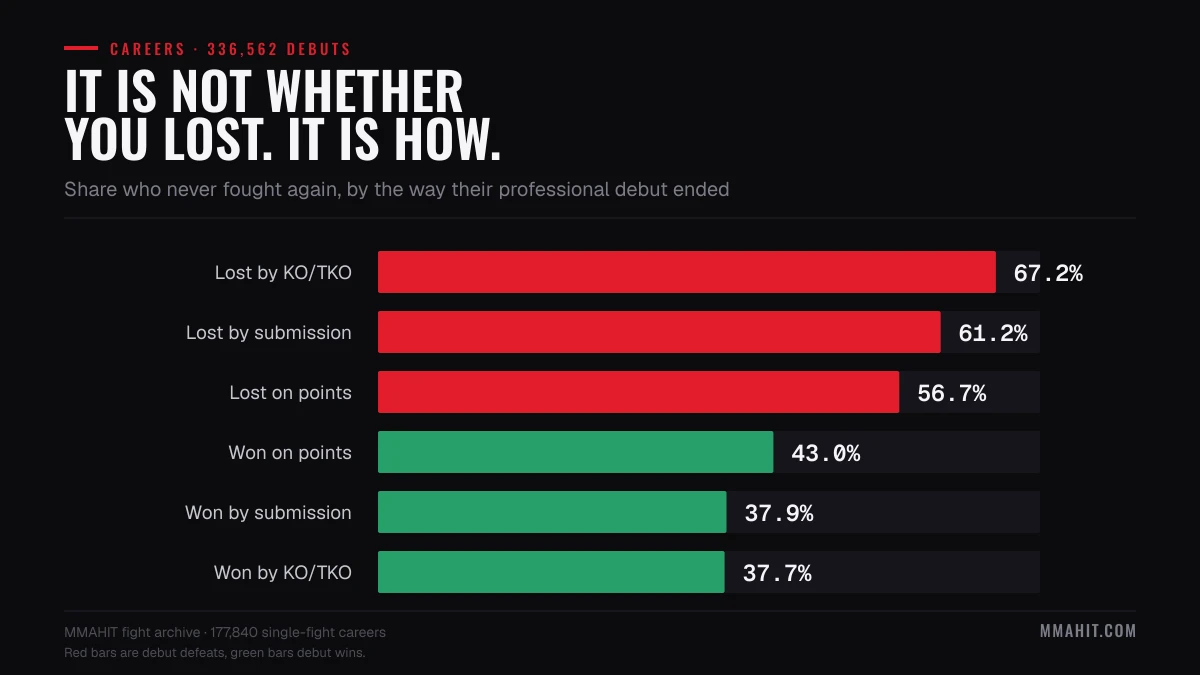
But sort the debut by the manner of the result and a clean gradient appears:
| How the debut ended | Fighters | Never fought again |
|---|---|---|
| Lost by KO/TKO | 74,925 | 67.2% |
| Lost by submission | 72,370 | 61.2% |
| Lost on points | 42,715 | 56.7% |
| Won on points | 33,133 | 43.0% |
| Won by submission | 47,921 | 37.9% |
| Won by KO/TKO | 51,831 | 37.7% |
Read the top three rows. Every one of those fighters lost. The result on the record is identical. But being knocked out makes you ten and a half points more likely to walk away than losing a decision does.
Now read the bottom three. Every one of those fighters won — and the man who won on points is five points more likely to quit than the man who finished his opponent.
The record book cannot see this. A win is a win and a loss is a loss. But the person who lived it clearly experiences those results as different things, and the archive can measure the difference across 336,562 careers.
There is something quietly humane in that gradient. It suggests the decision to continue is not really about the outcome at all. It is about what the night told you about yourself — whether you were beaten or whether you were hurt, whether you proved something or merely survived to a scorecard.
And it is happening more, not less
Split the debuts by the decade they happened in:
| Debut decade | Debuts | Never returned |
|---|---|---|
| 1990s | 5,346 | 34.3% |
| 2000s | 59,851 | 46.3% |
| 2010s | 162,892 | 50.7% |
| 2020s | 117,983 | 55.7% |
The share has climbed in every decade the sport has existed. In the 1990s, two in three debutants came back for more. Today, barely two in five do.
Part of that is a recording artefact — some 2020s debutants simply have not had their second fight yet. But the trend is far too large and too consistent to be only that. The 2000s figure has had two decades to settle and it is still twelve points above the 1990s.
The more likely explanation is that the sport got much bigger and much harder at the same time. There are vastly more places to have one professional fight than there were in 1998, and vastly more people who have trained seriously enough to be allowed one. What there is not, is more room at the top.
Where it happens
The pattern is not evenly spread:
- Mexico — 59.4% of debutants never return
- Russia — 58.4%
- Argentina — 57.4%
- Brazil — 52.6%
- England — 52.3%
- Poland — 49.2%
- France — 46.4%
- Canada — 44.7%
- United States — 44.5%
- Japan — 41.6%
Japan and the United States retain their debutants best; Mexico and Russia lose nearly six in ten. That ordering tracks the depth of each country's regional circuit — where there are more small shows to fight on, more fighters get a second booking.
The other end of the distribution
It is worth holding the 177,840 next to the men at the opposite extreme, because they belong to the same sport and the same archive.
| Fighter | Bouts | Career span |
|---|---|---|
| Shannon Ritch | 150 | 1998–2020 |
| Jay Ellis | 128 | 2005–2025 |
| Dan Severn | 127 | 1994–2012 |
| Jeremy Horn | 120 | 1996–2020 |
| Yuki Kondo | 117 | 1996–2025 |
| Ikuhisa Minowa | 116 | 1996–2022 |
Shannon Ritch fought 150 times. One hundred and seventy-seven thousand people fought once. Both facts describe the same sport, and only 1.8 percent of all fighters in the archive ever reach twenty bouts at all.
One name is missing from that table, and it belongs there. Travis Fulton is consistently reported as the most prolific fighter in the history of the sport, with a bout count above 320 — more than double Shannon Ritch. He does not appear anywhere in this archive, because his records are absent from the public database it draws on. We are noting him rather than pretending the table is complete: a "most fights" list that silently omits the record holder is not a list, it is an accident. Everything else in it was checked against public sources before publication, and Ritch's 150, Severn's 127 and Horn's 120 all match.
What this changes
The talent pyramid is not a pyramid. It is a spike sitting on a floor. There is no gentle slope from amateur to journeyman to contender — there is one fight, then a cliff, and then a very thin column of people who kept going.
Debut records are close to meaningless as a predictor. When more than half of all professionals never fight twice, a 1–0 record tells you almost nothing except that somebody was willing to take a fight against a man who probably was not coming back either.
Most of MMA's history was written by people who lost once and went home. They are not a footnote to the sport. Numerically, they are the sport. Every archive of this kind is mostly a record of the people it did not work out for — and that is worth remembering the next time a broadcast calls a 12–3 regional fighter a nobody.
Method: figures drawn from the MMAHIT fight archive, cross-checked against public records before publication, covering 336,562 fighters with at least one dated professional bout across 1,049,038 recorded fights. Career length is the count of dated bouts on a fighter's record; the debut is the earliest of them, taken as exactly one row per fighter — an earlier pass that matched on date alone double-counted the roughly 1.3 percent of fighters who fought twice on the same night in one-night tournaments, and those figures were discarded. Three limitations are worth stating: an archive of this size inevitably under-records the smallest regional shows; a fighter whose debut was recent may simply not have had a second bout yet, which inflates the 2020s figure specifically; and at least one prolific fighter — Travis Fulton, reported elsewhere at over 320 bouts — is missing from the source database entirely, so the career-length table above is a record of what this archive holds rather than a complete ranking of the sport. Jay Ellis reads 128 bouts here against 126 in a May 2025 write-up, the difference being two subsequent fights the archive has picked up.