Every fighter thanks his team. Every broadcast mentions the camp. The gym is treated as the most important thing about a fighter that is not the fighter himself — and almost nobody puts a number on it.
The MMAHIT archive records a team affiliation for 139,044 fighters across 38,546 distinct gyms. That is enough to ask two questions that usually get answered by reputation alone: does having a gym matter, and can you tell one gym from another by results?
Both answers turned out to be yes. The second one more interestingly than the first.
Having a gym at all
Start with the blunt version.
| Fighters | Bouts | Win rate | |
|---|---|---|---|
| Team on record | 133,192 | 607,981 | 53.6% |
| No team on record | 200,763 | 422,415 | 40.9% |
Nearly thirteen points. That is an enormous gap for a single binary fact — bigger than the gap between a 22-year-old and a 40-year-old.
And it is also, on its own, close to meaningless. Fighters whose gym is recorded are better documented, and better-documented fighters tend to be the ones with real careers. The "no team" column is full of the one-fight-and-gone crowd who make up half this archive. Of course they lose more.
So test it where that cannot be the explanation
If the gap is only a documentation artefact, it should shrink once both groups are restricted to fighters who actually had careers. Here is what happens instead:
| Career length | With a team | Without | Gap |
|---|---|---|---|
| 1+ bouts | 53.6% | 40.9% | +12.7 |
| 5+ bouts | 57.8% | 49.2% | +8.6 |
| 10+ bouts | 59.5% | 49.3% | +10.2 |
| 20+ bouts | 60.6% | 49.0% | +11.6 |
The gap narrows once, then stops narrowing and widens again. Among fighters with twenty or more professional bouts — men nobody could call under-documented — the ones with a team on record win 60.6 percent and the ones without win 49.0.
Then there is the test that removes the argument entirely: find the bouts where one man has a team and his opponent does not, and see who wins. Same night, same rules, same opponent quality by definition.
Across 142,608 such bouts, the fighter with a team won 68.7 percent of the time.
That is not a documentation artefact. Something about walking in attached to a programme is worth roughly nineteen points over a coin flip.
Which gyms, then
Restricting to gyms with at least sixty fighters on record — so a single champion cannot carry one — this is the top of the table:
| Gym | Fighters | Bouts | Win rate |
|---|---|---|---|
| Eagles MMA | 60 | 462 | 76.8% |
| Combate Vilamir | 78 | 279 | 75.3% |
| Pitbull Martial Arts Center | 72 | 361 | 74.5% |
| Fight Club Akhmat | 258 | 2,076 | 73.8% |
| Astra Fight Team | 123 | 1,399 | 71.7% |
| Kill Cliff FC | 89 | 1,739 | 71.2% |
| American Top Team | 283 | 4,840 | 70.6% |
| Roufusport | 81 | 800 | 70.0% |
Eagles MMA — the Nurmagomedov family gym in Dagestan — tops it at 76.8 percent. American Top Team posts 70.6 across the largest sample on the board, 4,840 bouts, which is arguably the more impressive number: sustaining seventy percent over that volume is harder than peaking above it over a few hundred.
Read this column carefully, though. A gym's win rate measures the fighters it has, not only the coaching it gives. Strong gyms recruit strong fighters, and this archive cannot separate the two. What it can do is something the win-rate column can't.
The real finding: a gym has a fingerprint
Across the whole archive, wins break down like this:
- KO/TKO — 36.4%
- Submission — 34.9%
- Decision — 26.5%
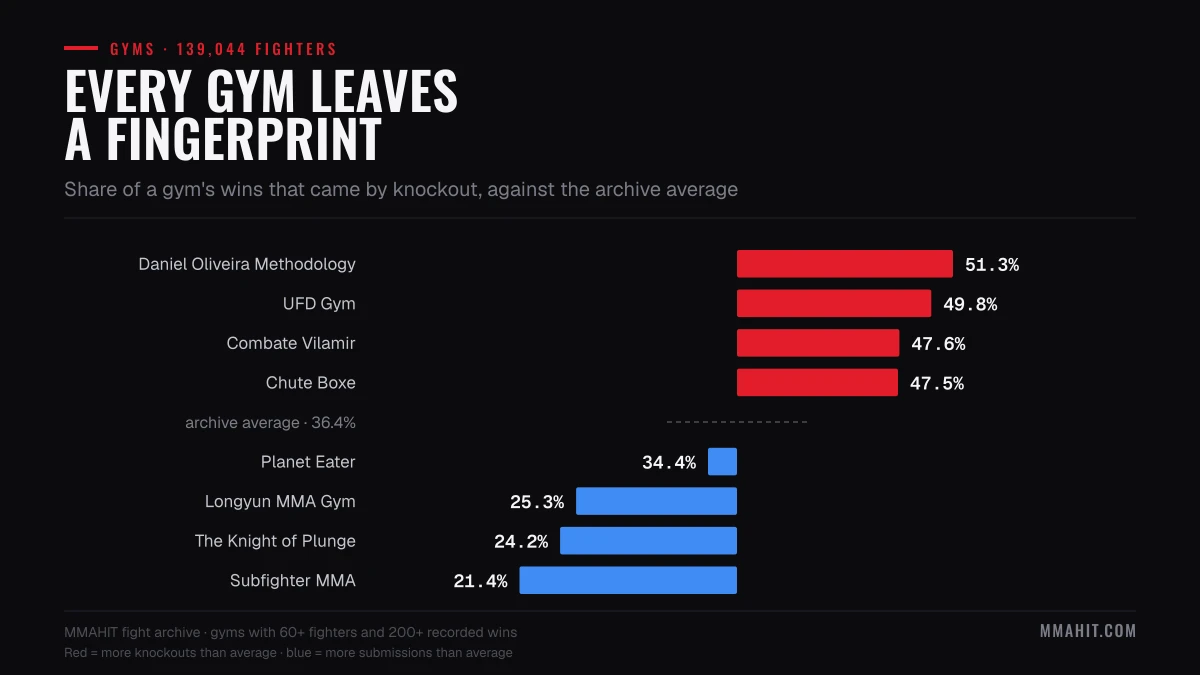
Now measure each gym against that baseline. The gyms furthest above it on knockouts:
| Gym | KO share of wins | vs baseline |
|---|---|---|
| Daniel Oliveira Methodology | 51.3% | +14.9 |
| UFD Gym | 49.8% | +13.4 |
| Sech Pro | 49.8% | +13.4 |
| Combate Vilamir | 47.6% | +11.2 |
| Chute Boxe | 47.5% | +11.1 |
And the gyms furthest toward submissions:
| Gym | Submission share of wins |
|---|---|
| Longyun MMA Gym | 46.8% |
| The Knight of Plunge | 46.2% |
| Planet Eater | 45.7% |
| Subfighter MMA | 44.8% |
| Trench Tech | 44.1% |
Look at the fifth row of the first table.
Chute Boxe is the Curitiba academy that produced Wanderlei Silva and built its entire identity on aggressive Muay Thai — forward pressure, knees, volume. It is probably the most famous striking gym in the sport's history.
The archive does not know any of that. It has never heard of Wanderlei Silva's reputation, does not read interviews, and has no concept of a fighting style. All it did was count how a few hundred fights ended. And it placed Chute Boxe eleven points above the sport's knockout average, in the same band as gyms whose names are literally built around striking.
Meanwhile a gym called Subfighter MMA finishes 44.8 percent of its wins by submission and only 21.4 percent by knockout — the inverse profile, and exactly what the name advertises.
That is the finding. A gym's method leaves a measurable trace in its results, strong enough to identify it without knowing anything else about the gym. Reputation in this sport is usually treated as folklore. Here it survives contact with a million fight records.
What this is good for
"Who does he train with" is a real question, not small talk. The head-to-head number says a fighter attached to a programme beats an unattached one nearly seven times in ten. Before style, before record, before reach — being in a room with coaches is the single largest binary advantage in this data.
A gym's win rate tells you who it recruits. Its finish profile tells you what it teaches. The second is the more useful number and almost nobody quotes it.
Expect the style, not just the outcome. A Chute Boxe fighter is measurably more likely to end the night with his hands than the average professional. That is not a narrative built after the fact — it is in the results before the fight starts.
Method: figures drawn from the MMAHIT fight archive. Team affiliation is recorded for 139,044 of 347,296 fighters (40.0%) across 38,546 distinct labels; "Independent", "Freelance" and equivalents are treated as the absence of a gym rather than as gyms. Three limitations are worth stating plainly. First, affiliation is self-reported and generally reflects a fighter's current gym, not necessarily the gym he was with for any given bout, so a career that spans several camps is attributed to the last one. Second, "no team on record" does not prove a fighter had no team — only that nobody wrote one down; the career-length and head-to-head controls are included precisely because that objection applies to the raw comparison. Third, and least fixable: gyms both train and recruit, and no archive can separate coaching from selection. The style-signature finding is the one least exposed to that, since it measures how a gym's fighters win rather than how often. Gym tables are restricted to at least 60 fighters, and the style tables additionally require more than 200 recorded wins.