Ask which division is the most exciting and you will get an argument. Ask which is the most violent and you can get an answer, because violence in this sport leaves a paper trail: how often a fight is finished, how it is finished, and how long it takes.
We measured every decisive bout in the MMAHIT archive against the weight class of the fighter contesting it — 925,754 bout-records across nine divisions. The result is one of the cleanest patterns anywhere in the data.
The table
| Division | Bouts | Finished | KO/TKO | Submission | Decision | Avg finishing round |
|---|---|---|---|---|---|---|
| Strawweight | 20,791 | 56.7% | 25.2% | 31.6% | 40.0% | 1.50 |
| Flyweight | 78,500 | 64.3% | 29.7% | 34.6% | 33.4% | 1.48 |
| Bantamweight | 128,002 | 66.4% | 31.3% | 35.1% | 31.6% | 1.47 |
| Featherweight | 156,997 | 68.4% | 32.8% | 35.6% | 29.7% | 1.45 |
| Lightweight | 169,682 | 70.3% | 34.9% | 35.4% | 27.8% | 1.43 |
| Welterweight | 157,685 | 73.1% | 37.7% | 35.4% | 25.2% | 1.41 |
| Middleweight | 101,677 | 75.4% | 41.4% | 34.0% | 22.6% | 1.38 |
| Light Heavyweight | 58,465 | 78.6% | 46.6% | 32.0% | 19.2% | 1.34 |
| Heavyweight | 53,955 | 80.8% | 54.4% | 26.4% | 17.2% | 1.32 |
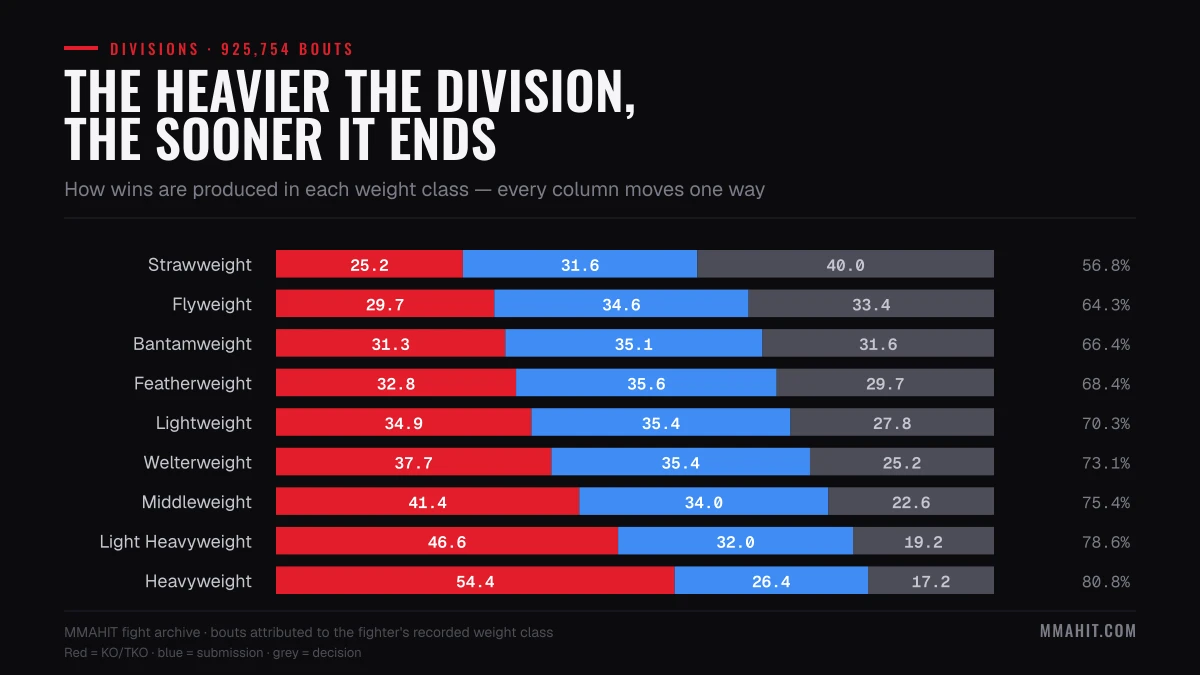
Read down any column and it moves in one direction, every step, across all nine divisions. Finish rate climbs from 56.7 to 80.8. Knockouts climb from 25.2 to 54.4. Decisions fall from 40.0 to 17.2. Finishes arrive earlier and earlier.
Patterns this clean are rare in a database of a million fights, and this one has no exceptions in it at all.
Four fights in five
A heavyweight bout ends inside the distance 80.8 percent of the time. A strawweight bout does so 56.7 percent of the time.
Put differently: watch a heavyweight fight and you are watching four fights in five that will not reach the judges. Watch a strawweight fight and it is closer to a coin flip.
And 54.4 percent of all heavyweight wins are knockouts — more than half of every victory in the division comes from a man being hit until he cannot continue. At strawweight that figure is a quarter.
The submission column does something different
Every other column marches. The submission column does not — it rises, peaks, and falls:
- Strawweight — 31.6%
- Flyweight — 34.6%
- Bantamweight — 35.1%
- Featherweight — 35.6%
- Lightweight — 35.4%
- Welterweight — 35.4%
- Middleweight — 34.0%
- Light Heavyweight — 32.0%
- Heavyweight — 26.4%
Submissions peak in the middle of the scale and fall away at both ends, and the two ends fall for opposite reasons.
At heavyweight, the submission is crowded out. It is not that heavyweights cannot grapple — it is that a heavyweight exchange rarely lasts long enough to become a grappling exchange. Something lands first. The knockout takes the fights the submission would otherwise have had.
At strawweight the pressure comes from the other side: less finishing power in the hands, more of the fight spent standing and scoring, and a much larger share of nights that simply go to the cards. The submission has to compete with the decision instead.
Featherweight to welterweight is the band where neither pressure dominates — enough power to threaten, not so much that the fight ends before the ground is reached.
Time compresses as weight rises
The last column is the quiet one. Among fights that are finished, the average finishing round falls from 1.50 at strawweight to 1.32 at heavyweight.
That looks small. It is not, because these are averages of a number that can only be 1, 2 or 3 in most bouts — a shift of 0.18 means a substantially larger share of heavyweight finishes land in the first round rather than the second.
The heavier the division, the sooner the ending arrives and the more likely it is to arrive at all. Both effects push the same way, and the fan-facing version of this is simple: a heavyweight fight is most likely to be decided in the five minutes you are most likely to miss.
What this actually means
"Most violent" has a real answer, and it is heavyweight by a distance. Highest finish rate, highest knockout share, lowest decision rate, earliest endings — the division leads every measure of violence in the archive simultaneously.
The lighter divisions are not less skilled, they are less conclusive. Strawweight and flyweight are decided by judges far more often, which is a statement about finishing power, not about the quality of the fighting.
If you want submissions, watch the middle. Featherweight through welterweight is where grappling wins the largest share of fights — better than heavyweight by nine points.
And the argument about whether the sport is getting more boring is a divisional argument in disguise. The lighter divisions have grown enormously as the sport has spread. A rising share of decisions across MMA is partly the same fights being fought by smaller men.
Method: figures drawn from the MMAHIT fight archive, covering 925,754 bout-records whose fighter carries a recorded weight class; draws and no contests are excluded. Bouts are attributed to the weight class recorded on the fighter's profile rather than to the contracted weight of that specific bout, which the archive does not store separately — for a fighter who moved divisions during a career, earlier bouts are therefore attributed to his final class. The effect is a mild blurring between adjacent divisions and would, if anything, flatten the pattern rather than create it. "Finished" means a recorded KO, TKO or submission. The average finishing round is computed over finishes only, so decisions do not drag it upward. Divisions below 2,000 recorded wins are omitted.