A fight ends in one of three ways, everybody knows: somebody gets knocked out, somebody taps, or the judges decide.
There is a fourth, and it is the only one where the ending is a decision made by someone who is not fighting. A doctor looks at a cut and waves it off. A corner throws in the towel. A fighter sits on his stool and does not stand up for the next round.
Across the MMAHIT archive these account for 12,896 wins — 2.59 percent of every victory on record. Roughly one fight in thirty-nine ends because a person chose to end it.
The three doors
| Ending | Wins | Share of all wins |
|---|---|---|
| Doctor stoppage | 5,318 | 1.07% |
| Retirement — did not answer the bell | 5,217 | 1.05% |
| Corner stoppage / towel | 2,361 | 0.47% |
| Combined | 12,896 | 2.59% |
The doctor and the fighter himself end fights at almost exactly the same rate. The corner — the coach who has known him for years and can see what the crowd cannot — accounts for less than half as many.
That ordering is worth sitting with. The man taking the punishment pulls himself out more than twice as often as the men whose job it is to protect him.
They happen early
| Round | Doctor | Retirement | Corner |
|---|---|---|---|
| 1 | 2,872 | 2,635 | 1,211 |
| 2 | 1,840 | 2,146 | 886 |
| 3 | 495 | 348 | 200 |
| 4 | 34 | 47 | 27 |
| 5 | 15 | 8 | 5 |
Nine in ten of these endings arrive in the first two rounds. Whatever the cut or the injury or the decision is, it is usually apparent early — and by round three the fight has almost always been resolved some other way.
Note also the shape of the retirement column against the doctor column. Doctor stoppages fall away sharply after round one; retirements hold up better into round two. A cut is visible immediately. The decision not to continue takes a round longer to arrive at.
The towel disappeared
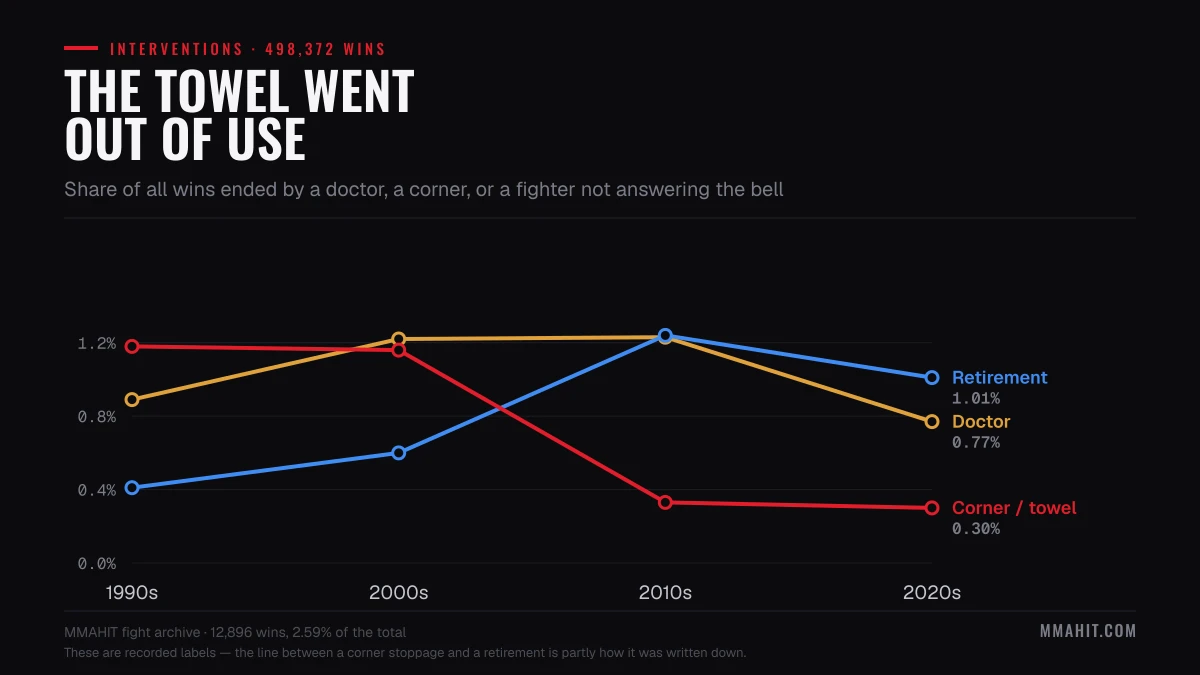
Split the same three endings by decade and one of them collapses:
| Decade | Doctor | Retirement | Corner |
|---|---|---|---|
| 1990s | 0.89% | 0.41% | 1.18% |
| 2000s | 1.22% | 0.60% | 1.16% |
| 2010s | 1.23% | 1.24% | 0.33% |
| 2020s | 0.77% | 1.01% | 0.30% |
The corner stoppage was the most common of the three in the nineties and is now the rarest by a factor of three. Over the same stretch, retirements went the other way — from 0.41 percent to around one percent, having overtaken the towel entirely.
A caveat before anyone builds a theory on that. These are recorded labels, not observed events, and the line between "the corner stopped it" and "he retired on his stool" is exactly the kind of distinction whose recording convention can shift without the underlying behaviour changing at all. A fighter who says he is done while his coach is already climbing the steps can honestly be written down either way. The collapse of one column into the other is consistent with a real change in how corners intervene, and equally consistent with a change in how databases describe it. The archive cannot separate those two, and neither will this article.
What can be said more safely is the total. Combined, these endings ran at 2.47 percent in the nineties, peaked at 2.99 percent in the 2000s, and sit at 2.09 percent in the 2020s — the lowest of any decade on record. Whatever is happening inside the categories, fights are being ended by third-party decision slightly less often now than twenty years ago.
The bigger the men, the more often somebody intervenes
| Division | Wins | Ended by doctor, corner or retirement |
|---|---|---|
| Flyweight | 38,348 | 2.20% |
| Bantamweight | 63,024 | 2.29% |
| Featherweight | 77,479 | 2.31% |
| Lightweight | 83,740 | 2.49% |
| Welterweight | 78,963 | 2.66% |
| Middleweight | 50,625 | 2.93% |
| Light Heavyweight | 29,059 | 3.21% |
| Heavyweight | 27,208 | 3.43% |
Another clean gradient, every step, in the same direction as everything else that scales with weight in this archive. A heavyweight fight is 56 percent more likely than a flyweight fight to be ended by somebody other than the two fighters and the judges.
The mechanism is not subtle: heavier hands open more cuts, break more orbital bones and produce more of the accumulated damage that makes a corner reach for the towel. The intervention rate is a proxy for how much harm the division does.
What this measures that nothing else does
It is the sport's only record of restraint. Every other outcome describes what the fighters achieved. This one describes what somebody watching decided they should not be allowed to continue doing.
And restraint is not distributed evenly. It is applied most where the damage is worst, which is at least the right direction — but at 3.43 percent even at heavyweight, it remains a rare event against a division that finishes 80.8 percent of its fights.
The fighter is his own most frequent protector. Retirements now outnumber corner stoppages roughly three to one. Whether that reflects better-informed fighters or corners that have become more reluctant is beyond what this archive can answer — but the shift is large, and it points at a change in who holds that decision.
Method: figures drawn from the MMAHIT fight archive, covering 498,372 wins. The three endings are extracted from the recorded method string and normalised case-insensitively across its spelling variants — "TKO (Doctor Stoppage)", "TKO (Doctor's Stoppage)", "TKO (Doctor Stoppage Cut)" and lower-case forms all count as a doctor stoppage; "TKO (Corner Stoppage)" and "TKO (Corner Threw in the Towel)" as a corner stoppage. The dominant wordings are TKO (Doctor Stoppage) at 5,231, TKO (Retirement) at 5,173 and TKO (Corner Stoppage) at 2,346. Two limitations govern how far this can be read. First, these categories are recorded by databases rather than observed by the archive, and the boundary between a corner stoppage and a retirement is a labelling judgment — the decade table should be read with that firmly in mind. Second, an intervention that prevents a fight from starting, or a bout stopped for a reason recorded only as a generic TKO, is invisible here; this counts what was written down, which is a floor rather than a full tally.